
Why a manual CDL costs more, and when it pays you back
The $1,000 gap between automatic and manual CDL training, what the extra money buys, and the honest answer about when that choice does not pay you back.
5 min readFenix Truck School
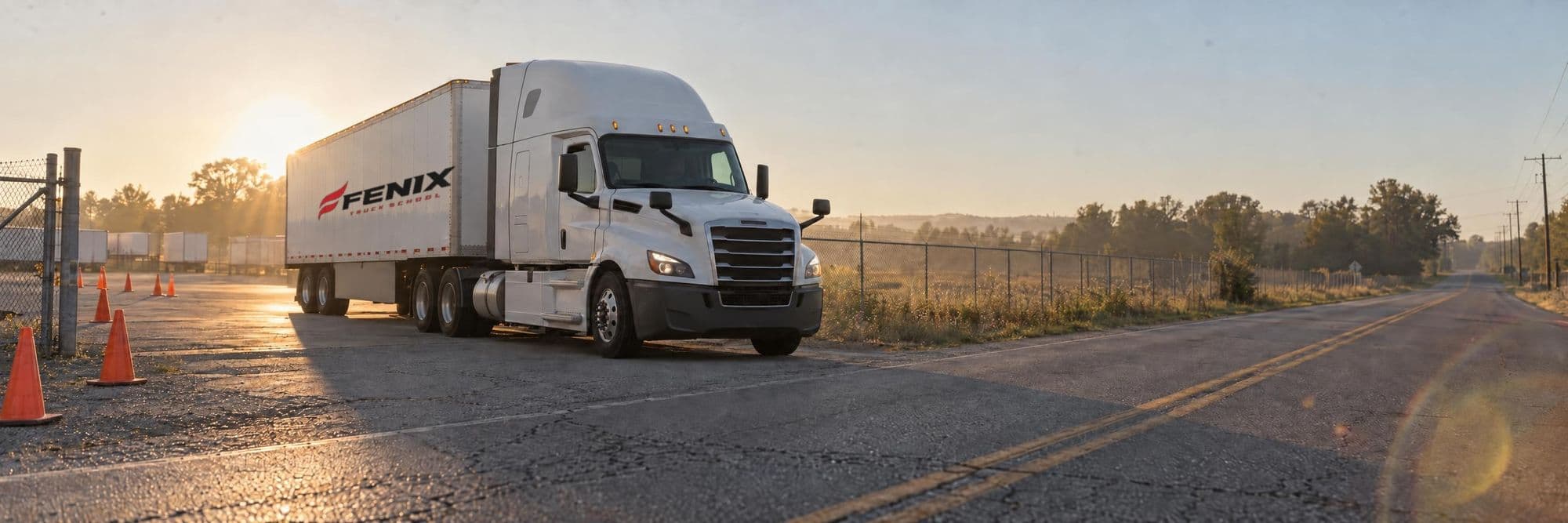
Class A automatic at Fenix is $2,750. Class A manual is $3,750. That $1,000 is the most consequential thousand dollars in the whole enrollment, and the sales answer — "manual opens more doors" — is true but incomplete.
Here is what the extra money actually buys, what it costs you in the other direction, and the cases where paying it is a waste.
This is information, not financial advice. Nobody but you knows what a thousand dollars means in your month.
The $1,000 is buying instructor time, not a different certificate
Both programs end with the same credential: a Class A commercial driver license. Both cover the same federal Entry-Level Driver Training curriculum. What differs is the truck you train in and the truck you test in.
Learning to shift a 10-speed non-synchronized transmission — float the gears, match engine speed to road speed, do it on a grade with a loaded trailer behind you — takes more seat time than learning to press a pedal. More seat time means more hours with an instructor in the passenger seat and more wear on a truck. That is the cost. Schools that charge the same for both are either subsidizing one with the other or not giving manual students the hours.
It also means a slightly higher chance of needing a second road test attempt, and the road test costs $510 whether you pass or not. Factor that in honestly rather than pretending manual students test at the same rate.
What the restriction actually is
This part is federal law, not school policy. Under 49 CFR 383.95, if you perform the skills test in a vehicle equipped with an automatic transmission, your license carries a restriction that bars you from operating a commercial motor vehicle with a manual transmission. It is printed on the card. It is visible to every recruiter, every DOT officer and every insurance underwriter who looks at your license.
It is not permanent. You can remove it by retesting in a manual vehicle — that is the whole mechanism, explained in how to remove the automatic restriction. But removing it later means finding a truck to test in, paying the test fee again, and taking a day off work to do it. That is why the decision feels bigger at enrollment than it does on paper.
When paying the $1,000 pays you back
The manual program is worth the money in a few specific situations, and they are narrower than the industry likes to admit.
You want to run flatbed, heavy haul, or specialized freight. These segments still run manuals in real numbers, and they pay above dry van. An unrestricted license is not optional there.
You want to drive older equipment, day cabs, or local vocational work. Dump trucks, mixers, regional construction fleets and small family carriers replace trucks slowly. A twelve-year-old tractor is very likely a manual.
You want to buy a truck eventually. Used manual tractors are cheaper than used automatics, and an owner-operator who cannot drive one has cut their own buying options in half. If owning your own truck is anywhere in your five-year plan, buy the unrestricted license now.
You want to leave a bad first job quickly. The restriction narrows who will hire you. A narrower market means less leverage when the first carrier turns out to be wrong, and the first year is exactly when people need to be able to move.
When it does not pay you back
Most new drivers go over-the-road or regional with a large carrier in their first year, and large carriers have spent a decade converting their fleets to automated manual transmissions. If that is your plan, the restriction will likely never come up. You will be handed an automatic on day one and drive an automatic for the next three years.
In that case the $1,000 buys you optionality you may never use. And $1,000 is not nothing when you are also covering a road test, state fees, a DOT physical and three or four weeks of reduced income.
There is also a timing argument. If the difference between $2,750 and $3,750 is the difference between starting Monday and starting in four months, start Monday. Four months of a driver's income is worth far more than a thousand dollars, and what a first-year driver actually earns makes that arithmetic plain. The restriction can be removed later. The four months cannot be recovered.
Side by side
| Class A Automatic | Class A Manual | |
|---|---|---|
| Tuition at Fenix | $2,750 | $3,750 |
| Road test (separate) | $510 | $510 |
| License restriction | Automatic-only restriction under 49 CFR 383.95 | None |
| Best fit | OTR and regional with a modern fleet | Flatbed, vocational, older equipment, future truck owner |
| Cost to change later | Retest in a manual, plus test fee and a day off | Not applicable |
| Time in program | 3–4 weeks | 3–4 weeks |
Note the last row. The manual program is not longer on the calendar at Fenix. It is denser.
How to actually decide
Answer one question honestly: do you know, today, what kind of freight you want to haul?
If the answer is no — and for most first-time students it is no — the question becomes a cash question rather than a career question. Take the automatic, get earning, and remove the restriction later if the work you end up wanting requires it. If the answer is yes and it involves flatbed, heavy haul, construction or your own truck, pay the thousand now. Retesting later will cost you more than a thousand dollars in lost days once you are working.
The comparison from the licensing side rather than the money side is laid out in automatic versus manual CDL, and it is worth reading before you commit either way.
What to do next
Call one recruiter at a carrier you would actually want to work for and ask two questions: what transmission is in the truck a new hire gets, and do they hire drivers with the automatic restriction. Their answer, for the freight you want, is worth more than any general advice. Then pick your program on the application and say which one you want, or call (904) 898-9989 and talk it through with someone who has watched 400 drivers make this exact decision.